
Voldorad
Description of the radar set, tactical-technical characteristics
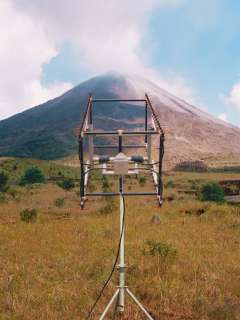
Figure 1: Voldorad

| Specifications | |
|---|---|
| frequency: | 1.274 GHz
(L band) |
| pulse repetition time (PRT): | 100 µs |
| pulse repetition frequency (PRF): | 10 kHz |
| pulsewidth (τ): | 0.8 µs |
| receiving time: | |
| dead time: | |
| peak power: | 60 W |
| average power: | |
| instrumented range: | 15 km |
| range resolution: | 120 m |
| accuracy: | |
| beamwidth: | 9° |
| hits per scan: | |
| antenna rotation: | |
| MTBCF: | |
| MTTR: | |
Voldorad
The Voldorad (Volcanic Doppler Radar) is a research radar that operates in the L band (IEEE designation) or D band (NATO designation). It is similar in design to a cloud radar and was developed to measure the size and speed of lava and ash ejecta from volcanoes.
The radar antenna consists of a 2-over-2 array of 24-element Yagi antennas mounted on a tripod that can be adjusted in azimuth and elevation. The transmitter works on a fixed frequency, which is slightly different for each device. The transmitter and receiver are housed in a small box. The data is displayed in real time on a standard computer. Depending on the version, the radar has a total weight of about 50 to 110 kg. It can be quickly moved using an all-terrain vehicle and can be set up at a distance of 0.5 to 5 km from the crater.