
AMES Type 15
Description of the radar set, tactical-technical characteristics
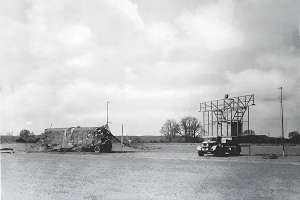
Figure 1: AMES Type 15 Mk.2


| Specifications | |
|---|---|
| frequency: | 192 … 209 MHz
(VHF band) |
| pulse repetition time (PRT): | |
| pulse repetition frequency (PRF): | 300 … 450 Hz |
| pulsewidth (τ): | 3,5 or 8 µs |
| receiving time: | |
| dead time: | |
| peak power: | 80 … 100 kW |
| average power: | |
| instrumented range: | 145 km |
| range resolution: | |
| accuracy: | |
| beamwidth: | 15° |
| hits per scan: | |
| antenna rotation: | 6 r.p.m. |
| MTBCF: | |
| MTTR: | |
AMES Type 15
The AMES Type 15 was an air surveillance radar operating in the VHF band (IEEE designation) or A band (NATO designation) that was developed after World War II. It is a mobile version of Type 7.
The antenna consisted of four rows of eight dipoles each in front of a common grid reflector with a height of approximately 10 feets. The antennas were rigidly attached to a rotating cabin. Phase comparison was used to roughly determine the altitude of the approaching target, the accuracy of which depended on the terrain because a large part of the energy was reflected at ground level in this frequency range. The transmitter and receiver were located in an RV 405 trailer. The operator workstations were located in an RV 409 trailer.
On the Type 15 Mk.1, the antenna for the IFF Mk. Ⅲ was still located on its own mast. On the Type 15 Mk.2, it was mounted above the primary radar antenna array. The modifications extended to Mk.4 with up to 150 kW pulse power.