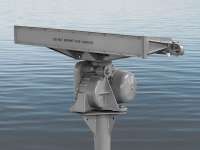
DECCA 202
Description of the radar set, tactical-technical characteristics

Figure 1: DECCA 202

| Specifications | |
|---|---|
| frequency: | 9 445 ± 35 MHz
(X band) |
| pulse repetition time (PRT): | |
| pulse repetition frequency (PRF): | 1 kHz |
| pulsewidth (τ): | 0,1 or 0,5 µs |
| receiving time: | |
| dead time: | |
| peak power: | 3 kW |
| average power: | |
| instrumented range: | |
| range resolution: | |
| accuracy: | |
| beamwidth: | β= 2,5° ; ε= 27° |
| hits per scan: | |
| antenna rotation: | |
| MTBCF: | |
| MTTR: | |
DECCA 202
DECCA 202 is operating in the X band (IEEE designation) or in the I band (NATO designation) maritime navigation radar, developed in the late 1960er.
A parabolic antenna with the typical wind deflectors at the ends of the reflector was usually used, but there are also versions with a 4-foot (≙ 1,2 m) long, end-fed slotted waveguide.
In the Swedish Navy, this radar was designated PN-801.