
AN/APS-19
Description of the radar set, tactical-technical characteristics
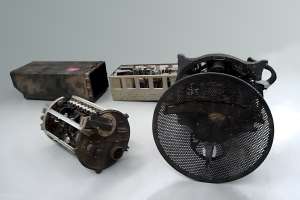
Figure 1: AN/APS-19

Sperry Corporation (1910-1986)
| Specifications | |
|---|---|
| frequency: | 9 335 … 9 415 MHz
(X band) |
| pulse repetition time (PRT): | |
| pulse repetition frequency (PRF): | |
| pulsewidth (τ): | |
| receiving time: | |
| dead time: | |
| peak power: | 40 kW |
| average power: | 40 W |
| instrumented range: | 44 NM (≙ 80 km) |
| range resolution: | |
| accuracy: | |
| beamwidth: | |
| hits per scan: | |
| antenna rotation: | |
| MTBCF: | |
| MTTR: | |
AN/APS-19
AN/APS-19 was operating in the X band (IEEE designation) or in the I band (NATO designation) light-weight airborne search and intercept radar in the early 1950s, which was developed in the early 1950s from the AN/APS-6. It was utilized on several aircraft, including the Douglas Skyraider AD-4N, McDonnell F2H-2N Banshee, Vought F4U-5N Corsair, Grumman F7F-4N Tigercat and Grumman F8F-1N Bearcat.
The Douglas Skyraider AD-4’s AN/APS-19 radar was installed in a pod mounted under the left wing.