AN/APS-103
Description of the radar set, tactical-technical characteristics
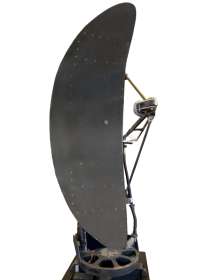
Figure 1: AN/APS-103
| Specifications | |
|---|---|
| frequency: | X band |
| pulse repetition time (PRT): | |
| pulse repetition frequency (PRF): | |
| pulsewidth (τ): | |
| receiving time: | |
| dead time: | |
| peak power: | |
| average power: | |
| instrumented range: | 160 NM (≙ 300 km) |
| range resolution: | |
| accuracy: | |
| beamwidth: | |
| hits per scan: | |
| antenna rotation: | |
| MTBCF: | |
| MTTR: | |
AN/APS-103
AN/APS-103 was operating in the X band airborne nodding height finding radar installed on top of the Lockheed EC/RC-121Q “Warning Star” airborne early warning and control aircraft. Working with the AN/APS-95 air search radar underneath the EC-121Q, the aircrew coud determine an unidentified aircraft’s altitude, distance, and direction.
The APS-103 replaced the AN/APS-45 and remained in service until 1978. The improvement over the APS-45 was increased range and an improved MTI system that could detect moving targets in front of a fixed clutter background.