
MR-650 “Podberezovik”
Description of the radar set, tactical-technical characteristics
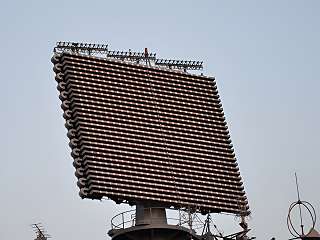
Figure 1: MR-650 “Podberezovik”


| Specifications | |
|---|---|
| frequency: | UHF band |
| pulse repetition time (PRT): | |
| pulse repetition frequency (PRF): | |
| pulsewidth (τ): | |
| receiving time: | |
| dead time: | |
| peak power: | |
| average power: | |
| instrumented range: | 270 NM (≙ 500 km) |
| range resolution: | |
| accuracy: | |
| beamwidth: | |
| hits per scan: | |
| antenna rotation: | |
| MTBCF: | |
| MTTR: | |
MR-650 “Podberezovik”
MR-650 “Podberezovik” (Cyrillic: МР-650 «Подберезовик») is a family of long-range radars used in maritime surveillance and target assignment, operating in the UHF band (IEEE designation) or in the C band (NATO designation).
The basic model, “Podberezovik-E,” features a transmitter with an amplitron in its output stage. Its antenna is a passive, frequency-controlled phased array measuring 7.22 × 3.0 meters, with 15 rows of slotted waveguides, each containing 28 single radiators.
The “Podberezovik-ET1” version employs a fully transistorized transmitter, though it does not match the power of the amplitron. To match its energy range, the antenna was doubled in height, now measuring 7.22 × 6.25 meters with 30 waveguide rows.
“Podberezovik-ET2” is a slimmed-down version that omits only the last stage with the transmitter tube from the basic version’s transmitter. It also uses the large antenna, resulting in about half the energetic range. A smaller fighter aircraft will be detected at 240 km instead of 400 km, and a sea-skimming cruise missile at 45 km instead of 70 km.