
AN/TPX-19 to TPX-23
Description of the radar set, tactical-technical characteristics
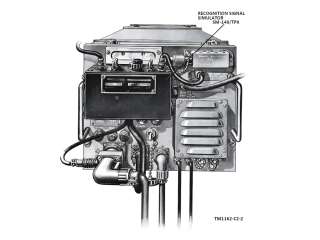
Figure 1: AN/TPX-19


US-American
| Specifications | |
|---|---|
| frequency: | 990 … 1040 MHz
(L band) |
| pulse repetition time (PRT): | |
| pulse repetition frequency (PRF): | |
| pulsewidth (τ): | |
| receiving time: | |
| dead time: | |
| peak power: | 1.5 kW |
| average power: | 0.7 … 1.2 µs |
| instrumented range: | 190 NM (≙ 350 km) |
| range resolution: | |
| accuracy: | |
| beamwidth: | |
| hits per scan: | |
| antenna rotation: | |
| MTBCF: | |
| MTTR: | |
AN/TPX-19 to TPX-23
The AN/TPX-19 to TPX-23 were identification interrogators operating in the L band (IEEE designation) or D band (NATO designation) within the IFF Mark Ⅹ SIF standard for the AN/AFX-6 airborne transponder. These different device designations result from the necessary adaptations for use in various primary radar systems and differs mainly by the antenna. The AN/TPX-19, for example, was used in the AN/TPS-1D and in SCR 584. In TPS-1, the IFF antenna was part of the primary radiator, and the transmit/receive feed was provided by a coaxial cable. The AN/TPX-20 was incorporated into the U.S. Nike Hercules air defense missile system sites. The AN/TPX-21 was used in the T-38 Skysweeper artillery radar.
In the TPX-19, several transmission frequencies could theoretically be used due to backward compatibility, but because of the standardization of the interrogation protocol, only frequency No. 3 was employed (nominal 1030 MHz).