AN/SPS-32
Description of the radar set, tactical-technical characteristics
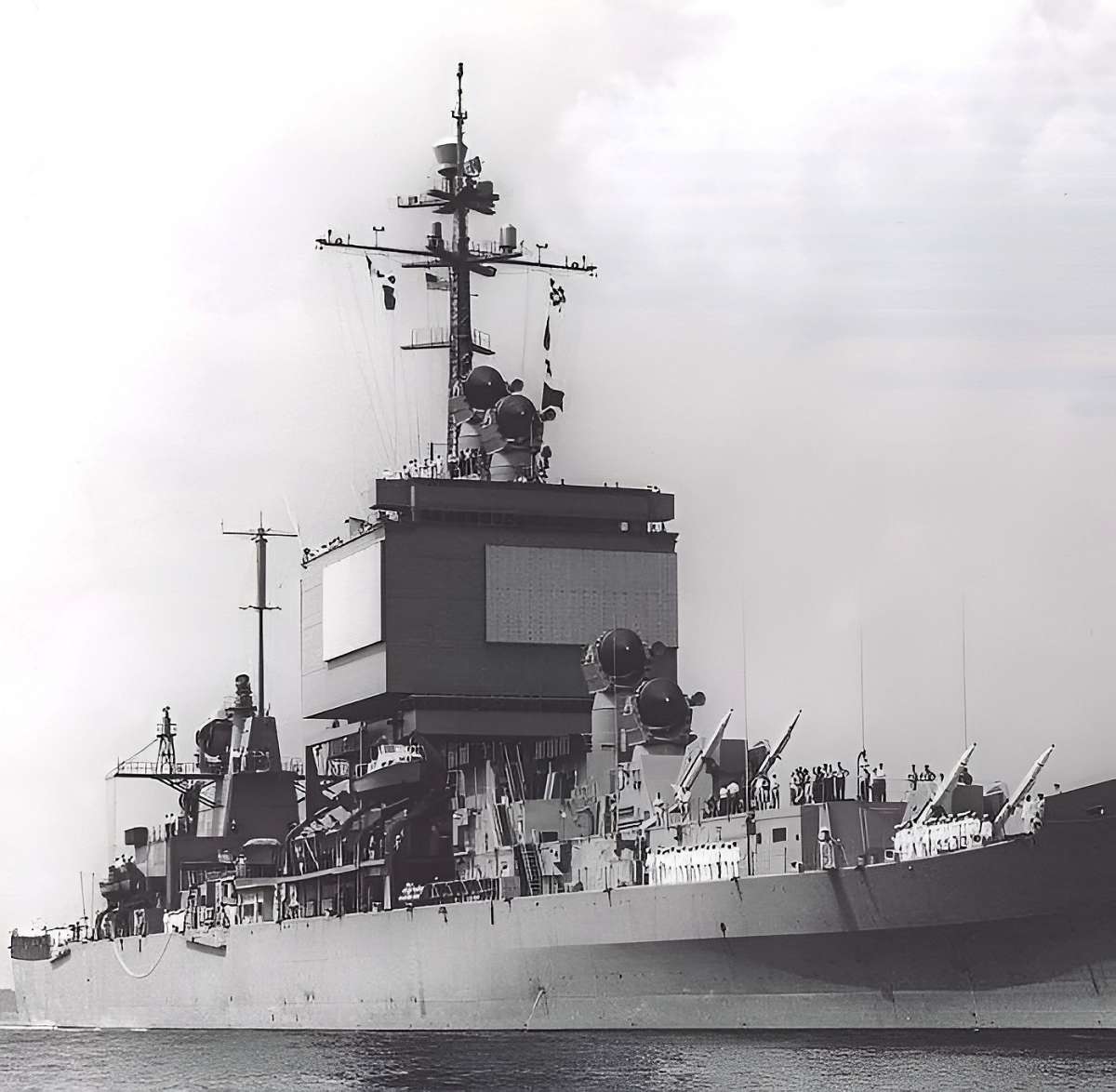
Figure 1: USS Long Beach equipped with the AN/SPS-32; at this stage of the development, the AN/SPS-33 was not yet installed
(The four parabolic antennas stacked on top of each other are AN/SPG-55)
Figure 1: USS Long Beach equipped with the AN/SPS-32; at this stage of the development, the AN/SPS-33 was not yet installed
(The four parabolic antennas stacked on top of each other are
AN/SPG-55)

| Specifications | |
|---|---|
| frequency: | 420 … 450 MHz
(UHF band) |
| pulse repetition time (PRT): | |
| pulse repetition frequency (PRF): | 200 Hz |
| pulsewidth (τ): | 20 µs |
| receiving time: | |
| dead time: | |
| peak power: | 1,5 MW |
| average power: | |
| instrumented range: | 400 NM (≙ 740 km) |
| range resolution: | |
| accuracy: | |
| beamwidth: | β= 7° ; ε= 50° |
| hits per scan: | |
| antenna rotation: | |
| MTBCF: | |
| MTTR: | |
AN/SPS-32
AN/SPS-32 (Billboard) was operating in the UHF band (IEEE designation) or in the B band (NATO designation) naval 2D air surveillance radar. It served as a target search and acquisition radar for the AN/SPS-33.
The radar used four fixed, frequency-controlled phased arrays. Each rectangular array measured 40 by 20 feet (12.2 by 6.1 m). Eighteen linear antenna arrays, stacked one above the other and fed in series via coaxial cables, were used. The detour lines were designed as wave-shaped loops. Electronic scan was only possible for the azimuth angle.
Only two ships were equipped with the SPS-32 and SPS-33 radar pair:
- the aircraft carrier USS Enterprise (CVN-65) and
- the missile cruiser USS Long Beach (CGN-9)
Further installations were canceled because the system was too heavyweight and too expensive.