
AN/APG-6
Description of the radar set, tactical-technical characteristics
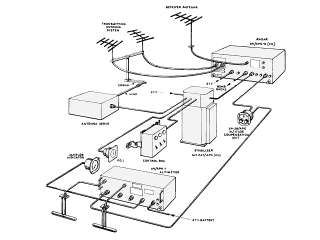
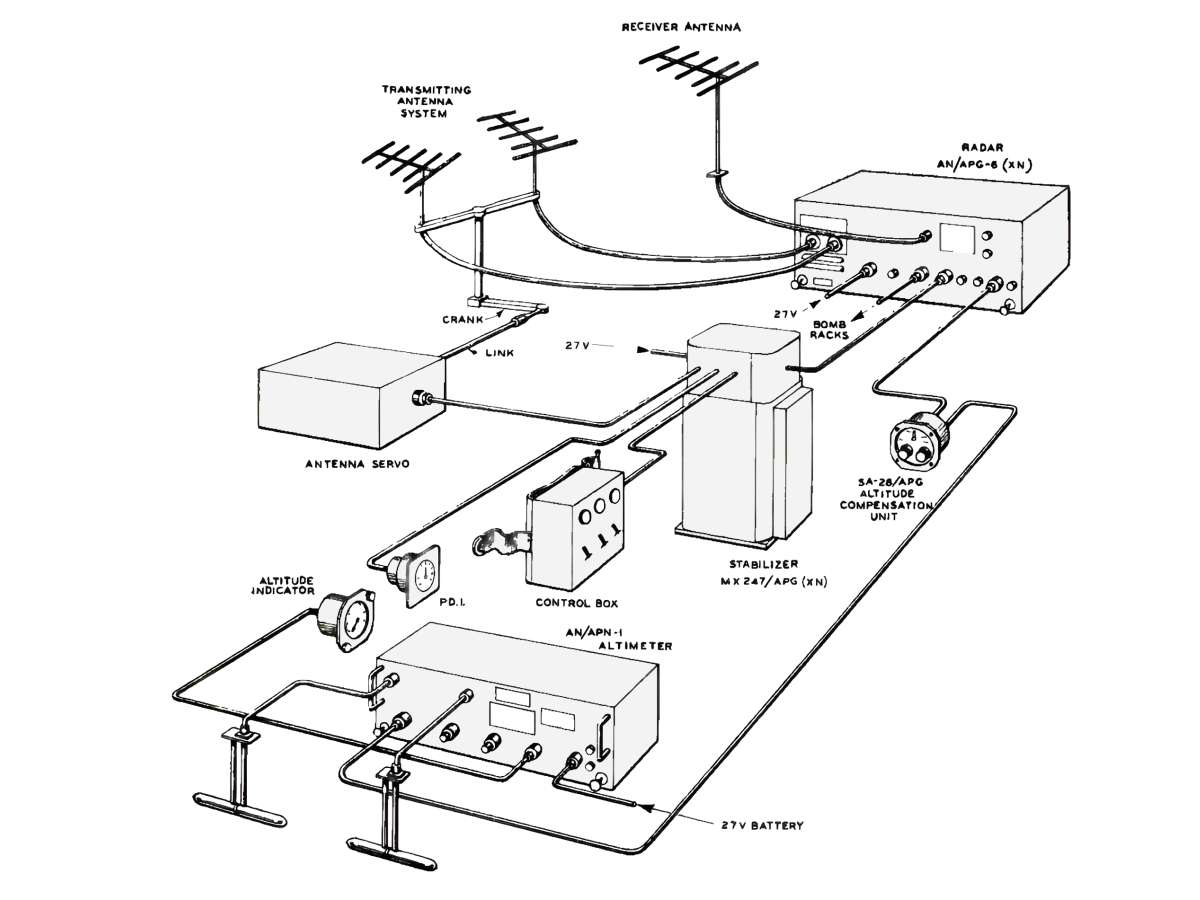
Figure 1: AN/APG-6

| Specifications | |
|---|---|
| frequency: | 405 … 415 MHz
(UHF band) |
| pulse repetition time (PRT): | |
| pulse repetition frequency (PRF): | |
| pulsewidth (τ): | |
| receiving time: | |
| dead time: | |
| peak power: | |
| average power: | 2 W |
| instrumented range: | |
| range resolution: | |
| accuracy: | |
| beamwidth: | |
| hits per scan: | |
| antenna rotation: | |
| MTBCF: | |
| MTTR: | |
AN/APG-6
The AN/APG-6, also known as the “Super Sniffer,” was a frequency-modulated continuous wave radar operating in the UHF band (IEEE designation) or in the B7 band (NATO designation) which, together with the AN/APN-1 altimeter, was used as an aid for low-altitude bombing.
The AN/APG-6 is an improved version of the AN/APG-4. It featured a superheterodyne receiver instead of a linear receiver and had higher transmission power.