
DECCA 50
Description of the radar set, tactical-technical characteristics
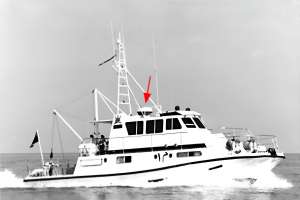
Figure 1: DECCA 50


| Specifications | |
|---|---|
| frequency: | 9415 … 9475 MHz
(X band) |
| pulse repetition time (PRT): | |
| pulse repetition frequency (PRF): | 1,5 kHz |
| pulsewidth (τ): | 0,1 µs |
| receiving time: | |
| dead time: | |
| peak power: | 1.5 to 3 kW |
| average power: | 45 W |
| instrumented range: | 12 NM (≙ 22 km) |
| range resolution: | |
| accuracy: | |
| beamwidth: | 3° |
| hits per scan: | |
| antenna rotation: | 23 r.p.m. |
| MTBCF: | |
| MTTR: | |
DECCA 50
DECCA 50 or DECCA 050 was a navigation radar for small boats operating in the X band (IEEE designation) or in the I band (NATO designation). The Decca 50 is a two-unit radar system with a slotted waveguide antenna. The transmitter used a magnetron. DECCA 50 Mk.Ⅱ (so called: “Mini Radar Super 050”) provided doubled pulse power of 3 kW. All the radar electronics are housed in a waterproof fiberglass radome weighing about 25 kg. The display used a 9 inch cathode ray tube. It was connected to the antenna unit by a single plug-in cable, can be mounted on a table, bulkhead, or deckhead.
The radar was introduced in January 1972.