
MR-350 Podkat
Description of the radar set, tactical-technical characteristics
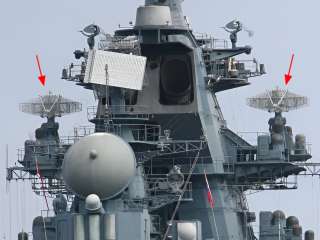
Figure 1: MR-350 Podkat


| Specifications | |
|---|---|
| frequency: | S band |
| pulse repetition time (PRT): | |
| pulse repetition frequency (PRF): | |
| pulsewidth (τ): | |
| receiving time: | |
| dead time: | |
| peak power: | |
| average power: | |
| instrumented range: | 20 NM (≙ 37 km) |
| range resolution: | |
| accuracy: | |
| beamwidth: | |
| hits per scan: | |
| antenna rotation: | |
| MTBCF: | |
| MTTR: | |
MR-350 Podkat
The MR-350 Podkat (Cyrillic: МР350 «Подкат», NATO designation: “Strut Pair C”) is a surface-to-surface missile warning radar operating in the S band (IEEE designation) or in the E/F band (NATO designation) for surveillance of extremely low-flying ship-to-ship missiles.
It is a successor to the MR-320 “Topaz”. The first radar sets also used its antennas and hydraulically stabilized turntables. Later versions were equipped with reflectors with more rounded corners.
The antenna consisted of two parabolic reflectors in a dual-faced configuration, originally intended to increase the data renewing rate, but later used with a slightly different tilt to estimate a target’s altitude.