
Type 9
Description of the radar set, tactical-technical characteristics
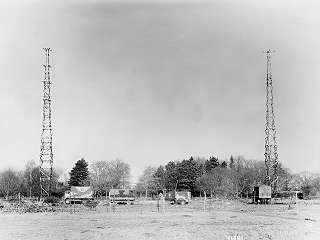
Figure 1: Type 9


UNITED KINGDOM
| Specifications | |
|---|---|
| frequency: | 40 … 50 MHz
(HF band) |
| pulse repetition time (PRT): | |
| pulse repetition frequency (PRF): | |
| pulsewidth (τ): | |
| receiving time: | |
| dead time: | |
| peak power: | 300 kW |
| average power: | |
| instrumented range: | 130 NM (≙ 240 km) |
| range resolution: | |
| accuracy: | |
| beamwidth: | |
| hits per scan: | |
| antenna rotation: | |
| MTBCF: | |
| MTTR: | |
Type 9
The AMES Type 9, also known as Chain Home (Mobile), was a mobile surveillance radar for ground-controlled intercept (GCI) during World War II, operating in the HF band (IEEE designation) or A2 band (NATO designation). Its primary task was to replace the original Chain Home radars if any were knocked out by air attack. They were also used on the British coast as gap filler.
It consisted of 13 heavy vehicles to transport the radar equipment, two collapsible 105-foot towers (≙ 32 m) for the antenna, and 60 personnel, and could detect aircraft at a distance of up to 150 miles, depending on their altitude. After relocation, it took about two days to set up and become operational at the new location.