
Type 52
Description of the radar set, tactical-technical characteristics
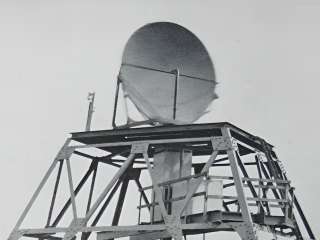
Figure 1: Type 52


 ALLEN WEST & CO., Ltd.
Brighton, England
| Specifications | |
|---|---|
| frequency: | 3 GHz
(S band) |
| pulse repetition time (PRT): | |
| pulse repetition frequency (PRF): | 1 000 Hz |
| pulsewidth (τ): | 2 µs |
| receiving time: | |
| dead time: | |
| peak power: | 500 kW |
| average power: | |
| instrumented range: | 80 NM (≙ 148 km) |
| range resolution: | |
| accuracy: | |
| beamwidth: | |
| hits per scan: | |
| antenna rotation: | 6 r.p.m. |
| MTBCF: | |
| MTTR: | |
Type 52
Type 52 was a land-based surveillance radar operating in the S band (IEEE designation) or in the E/F band (NATO designation), which was used for the detection and plotting of surface vessels and very low flying aircraft. It was used in Great Britain as the Standard CHEL/CD during the final years of the war.
The radar used a symmetrical parabolic reflector on a gantry. The radar electronics are basically identical to those used in the Royal Navy’s Type 277, but were equipped with a slightly more powerful transmitter.