
Type 5
Description of the radar set, tactical-technical characteristics
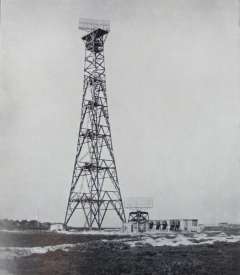
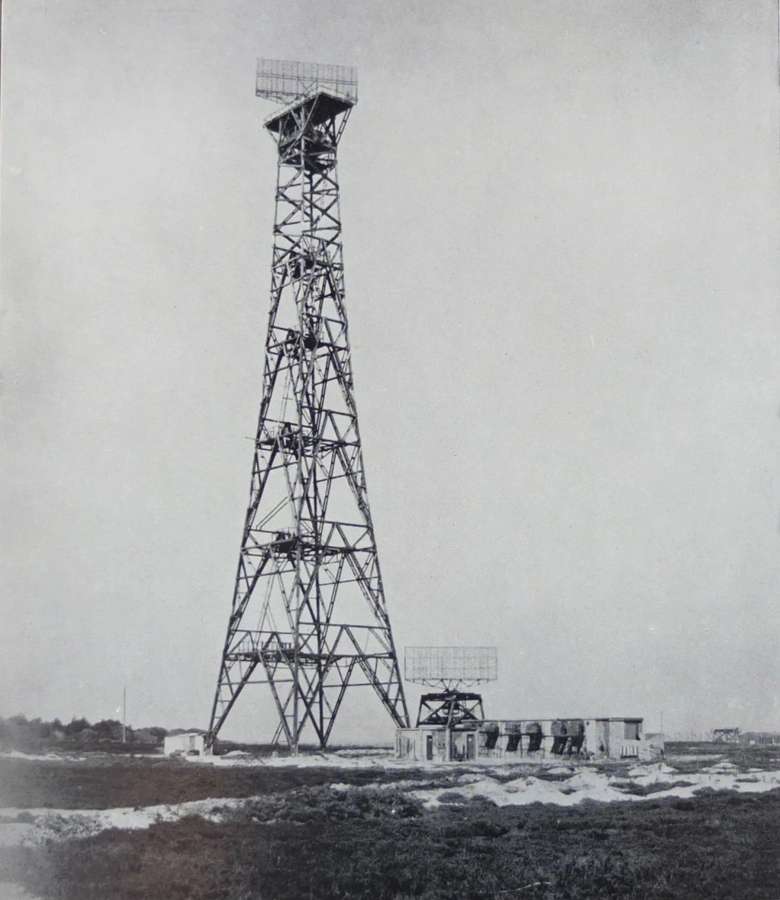
Figure 1: Type 5 Mk. 2A and 2B

UNITED KINGDOM
| Specifications | |
|---|---|
| frequency: | 200 MHz
(VHF band) |
| pulse repetition time (PRT): | |
| pulse repetition frequency (PRF): | 400 Hz |
| pulsewidth (τ): | 3 µs |
| receiving time: | |
| dead time: | |
| peak power: | 150 kW |
| average power: | |
| instrumented range: | 90 mi (≙ 145 km) |
| range resolution: | |
| accuracy: | |
| beamwidth: | 20° |
| hits per scan: | |
| antenna rotation: | |
| MTBCF: | |
| MTTR: | |
Type 5
Type 5 was operating in the VHF band (IEEE designation) or in the A band (NATO designation) long-range early warning and fighter-direction radar. It was a variant of the AMES Type 2 (Chain Home Low), but if used outside of Britain it was referred to as Chain Overseas Low (COL).
The antenna consists of an array of 4 rows, each with 5 dipoles, positioned at a distance of 1/8 λ from the wire mesh reflector. The following versions were available:
- Type 5 Mk 1 with a manually rotated antenna and more accurate direction finding by measuring the position of the null between the main and the first side lobe;
- Type 5 Mk 2A, installed on the ground, with a rotary motor;
- Type 5 Mk 2B, like Mk 2A, but mounted on a high tower.