
Blue Hawk
Description of the radar set, tactical-technical characteristics
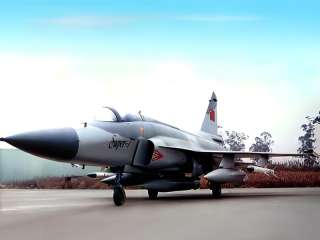
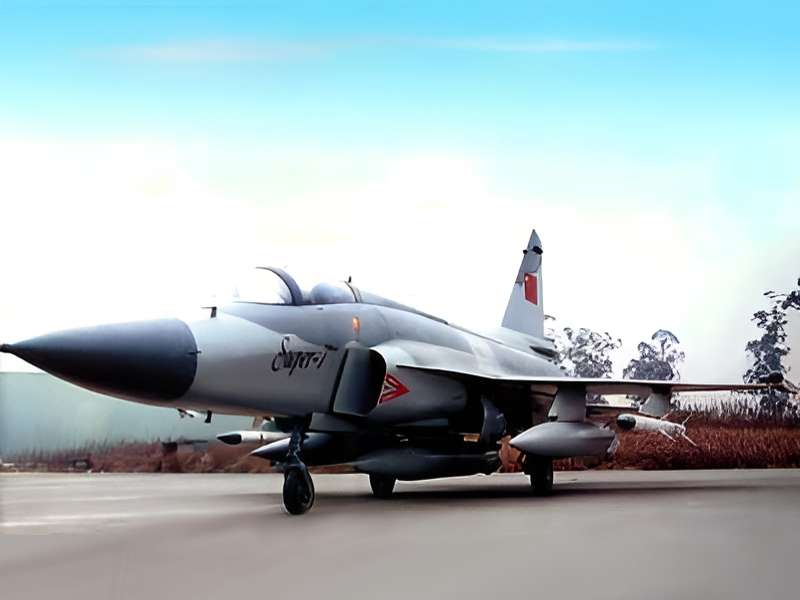
Figure 1: Chengdu Super 7

| Specifications | |
|---|---|
| frequency: | 9,6 … 9,9 GHz
(X band) |
| pulse repetition time (PRT): | |
| pulse repetition frequency (PRF): | 0,8 … 120 kHz |
| pulsewidth (τ): | |
| receiving time: | |
| dead time: | |
| peak power: | 8 kW |
| average power: | 160 W |
| instrumented range: | 80 NM (≙ 148 km) |
| range resolution: | |
| accuracy: | |
| beamwidth: | |
| hits per scan: | |
| antenna rotation: | |
| MTBCF: | 250 h |
| MTTR: | |
Blue Hawk
Blue Hawk is a low-cost multimode radar for lightweight fighters operating in the X band (IEEE designation) or in the I band (NATO designation). It can identify and simultaneously track up to 96 different targets.
The system elements include a mechanical scanning planar slotted array antenna (sized for platform application), a high-power transmitter using an air-cooled, ring bar TWT, a two-channel microwave receiver/exciter, and a digital processor for signal, data, and display applications. An integrated continuous-wave illuminator is available as an option for medium-range air-to-air missile control.
The Blue Hawk, which weighs 107 kg. Noteworthy is the high number of COTS-components. This radar was unveiled in August 1992 and was supposedly chosen for the Chengdu Super 7MG (NATO designation: “Fishcan”) as a direct replacement for the Skyranger system.