
AN/MPQ-14
Description of the radar set, tactical-technical characteristics
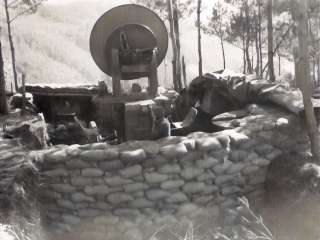
Figure 1: AN/MPQ-14

 Hersteller:
General Electric
| Specifications | |
|---|---|
| frequency: | 2 740 … 2 960 MHz
(S band) |
| pulse repetition time (PRT): | |
| pulse repetition frequency (PRF): | 1.1 kHz |
| pulsewidth (τ): | 0.8 µs |
| receiving time: | |
| dead time: | |
| peak power: | 200 kW |
| average power: | 180 W |
| instrumented range: | 10 NM (≙ 18 km) |
| range resolution: | |
| accuracy: | |
| beamwidth: | |
| hits per scan: | |
| antenna rotation: | |
| MTBCF: | |
| MTTR: | |
AN/MPQ-14
AN/MPQ-14 is operating in the S band (IEEE designation) or the E band (NATO designation) radar system for ground-directed bombing during the Korean War. It was a part of the so-called Radar Course Directing Central.
The AN/MPQ-14 automatically tracks friendly aircraft, computes a course from the aircraft to a predetermined ground target, and guides the aircraft over the ground target. At the proper instant, the system automatically commands the release of a bomb.
The AN/MPQ-14 is a further development of the AN/MPQ-2A. AN/MPQ-14 and AN/MPQ-14A differ in the radio set used.
Source:
- Military Standardization Handbook, United States Radar Equipment Manual TM 11-487C-1 1965, p. 404ff