
Credo
Description of the radar set, tactical-technical characteristics
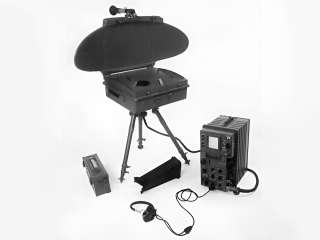
Figure 1: Credo



| Specifications | |
|---|---|
| frequency: | 15,7 … 16,6 GHz
(Ku band) |
| pulse repetition time (PRT): | |
| pulse repetition frequency (PRF): | 4 000 Hz |
| pulsewidth (τ): | 0,5 µs |
| receiving time: | |
| dead time: | |
| peak power: | 0,5 W |
| average power: | |
| instrumented range: | 10 km |
| range resolution: | 100 m |
| accuracy: | |
| beamwidth: | |
| hits per scan: | |
| antenna rotation: | |
| MTBCF: | |
| MTTR: | |
Credo
Credo (Cyrillic: «Кредо», alternative designations: PSNR-5, from: Perenosnoy Stantsii Nazemnoy Razvedki, i.e.: portable ground reconnaissance station, GRAU-Index: 1RL133, NATO-Codename: “Tall Mike”) is operating in the Ku band (IEEE designation) or in the J band (NATO designation) ground tactical acquisition and surveillance radar.
It is a battlefield radar distributed by Kintex, designed for searching, capturing, tracking, and pinpointing the locations of moving ground targets, including individuals, groups of people, and vehicles. Additionally, it can monitor low-flying aircraft and coastal surface vessels.
The radar system comprises two main units: a receiver/transmitter and an antenna unit, along with a display unit, a tripod, a headset, cables, and a battery supply unit. It can be mounted on various combat vehicles, drawing power from the vehicle, or set up on a tripod powered by a battery. While it can be operated by a single person, transporting the equipment for mobile use requires two people.
Credo is a pulse-Doppler, pseudo-coherent system with a high degree of natural interference suppression. It offers the option to manually tune to one of eight fixed frequencies for improved noise protection. Two operational modes are available: one with moving target selection and one without, allowing for adaptability to different environmental conditions. The display of moving targets is both visual and audible, and an experienced operator can identify the type of target using the acoustic indication in a headset.
The radar is state of the art from the early 1980s. It was used extensively during the Afghan War.