
AN/APN-131
Description of the radar set, tactical-technical characteristics
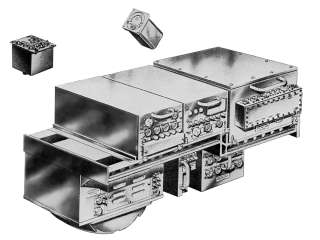
Figure 1: AN/APN-131


 Laboratory For Electronics, Inc.
| Specifications | |
|---|---|
| frequency: | 9 790 … 9 810 MHz
(X band) |
| pulse repetition time (PRT): | |
| pulse repetition frequency (PRF): | 8 … 125 kHz |
| pulsewidth (τ): | |
| receiving time: | |
| dead time: | |
| peak power: | |
| average power: | 3 W |
| instrumented range: | 12 NM (≙ 22 km) |
| range resolution: | |
| accuracy: | ± 2% |
| beamwidth: | |
| hits per scan: | |
| antenna rotation: | |
| MTBCF: | |
| MTTR: | |
AN/APN-131
AN/APN-131 is operating in the X band (IEEE designation) or in the I band (NATO designation) Doppler navigation radar, used in F-105, T-39B, TF-8A. The AN/APN-131 would automatically supply the pilot with continual position coordinates, ground speed, wind direction, distance to target, heading and other pertinent information.
The radar is fitted with a dielectric lens antenna that provides three beams fed by a power-splitter. The transmitter uses a repeller klystron master oscillator and three two-cavity klystrons as power amplifier in cascade. The pulse-repetition frequency (PRF) varies with the airplane’s altitude for optimum range considerations. A 125-kHz PRF is used at 2,000 ft; an 8-kHz rate at 40,000 ft.
Source:
- Military Standardization Handbook, United States Radar Equipment Manual TM 11-487C-1 1965, p. 785ff
- “Doppler Guiding Fighter Plane”, in ‘Electronics’, McGraw-Hill, November 27, 1959, VOL. 32, No. 48 , S. 49