
MHR ISR
Description of the radar set, tactical-technical characteristics
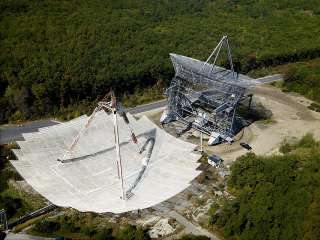
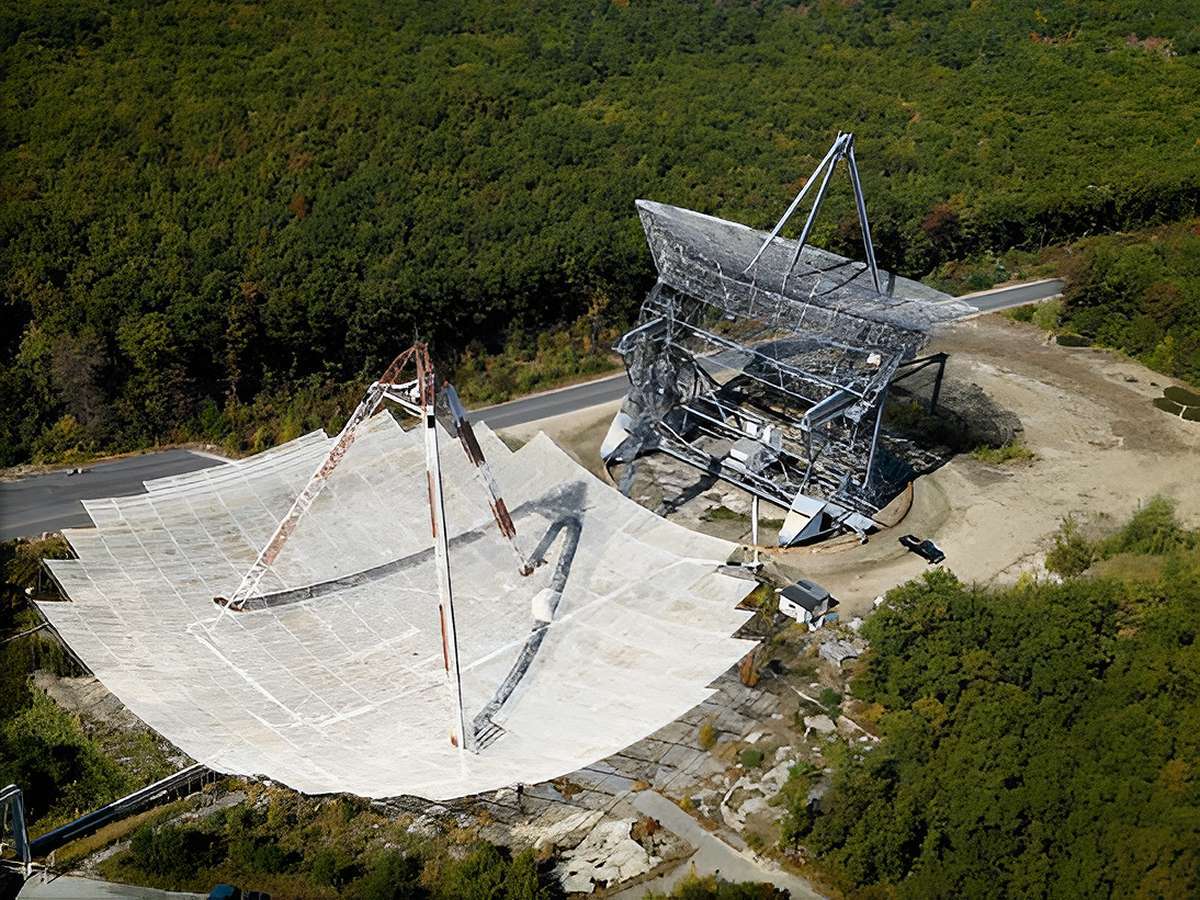
Figure 1: MHR ISR
| Specifications | |
|---|---|
| frequency: | 440,2 MHz
(UHF band) |
| pulse repetition time (PRT): | 2 ms |
| pulse repetition frequency (PRF): | |
| pulsewidth (τ): | 10 or 32 µs |
| receiving time: | |
| dead time: | |
| peak power: | 2,5 MW |
| average power: | |
| instrumented range: | 1 000 km |
| range resolution: | 1,5 km or 300 m |
| accuracy: | |
| beamwidth: | |
| hits per scan: | |
| antenna rotation: | |
| MTBCF: | |
| MTTR: | |
MHR ISR
The Millstone Hill Incoherent Scatter Radar (MHR ISR) is a research radar in Millstone (Massachusets, USA, 42°37'08.39" N 71°29'28.6" W) operating in the UHF band (IEEE designation) or in the B8 band (NATO designation) to study the dynamics of thermal plasma in Earth’s ionosphere. The radar detects the very weak Thomson scattering from free electrons in the ionosphere, which are electrostatically influenced by various ion species, enabling the creation of complete altitude profiles of plasma parameters.
The radar uses two antennas alternately. The fixed antenna with a diameter of 220 feet, aligned toward the zenith and standing tall, was installed in 1963. An additional turnable and swiveling antenna with a diameter of 150 feet was installed in 1977. The transmitter used two klystrons as power amplifiers, each with a pulse power of 1.25 MW (150 kW average). The transmitted 32-µs-pulse is bi-phase-modulated using a 16-bit complementary code.