
Shmel
Description of the radar set, tactical-technical characteristics
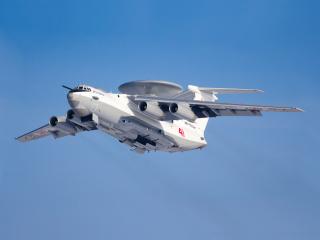
Figure 1: Berijew A-50 Shmel

 Elektrobaukonzern WEGA
| Specifications | |
|---|---|
| frequency: | S band |
| pulse repetition time (PRT): | |
| pulse repetition frequency (PRF): | |
| pulsewidth (τ): | |
| receiving time: | |
| dead time: | |
| peak power: | 1 MW |
| average power: | |
| instrumented range: | 400 km |
| range resolution: | |
| accuracy: | |
| beamwidth: | |
| hits per scan: | |
| antenna rotation: | |
| MTBCF: | |
| MTTR: | |
Shmel
The Shmel (Cyrillic: «Шмель», “bumblebee”) is an airborne 3D early warning radar operating in the S band (IEEE designation) or F band (NATO designation), installed in the Beriev A-50 (a converted Ilyushin IL-76MD military transport aircraft). The aircraft also features additional optical and radio reconnaissance equipment and has been assigned the NATO reporting name Mainstay.
The antenna is a 10 × 1.7 m frequency-controlled phased array composed of horizontally arranged slotted waveguides. The transmitter is fully coherent and uses a klystron as a power amplifier. There are five automated workstations, initially equipped with large-format cathode ray tube color screens.
Designed in the 1970s and 1980s, the radar has undergone several upgrades (Shmel-M and Shmel-2), mainly to improve radar data processing, increase fighter guidance from 12 to 30, and boost target tracking from about 50–60 up to 300. The workstations received more modern LCD displays.