
HALO 2000, HALO 3000
Description of the radar set, tactical-technical characteristics
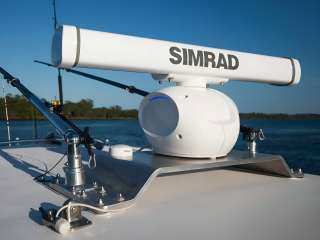
Figure 1: HALO 3000 with 3 ft antenna


| Specifications | ||
|---|---|---|
| Halo 2000 | Halo 3000 | |
| frequency: | X band | |
| pulse repetition time (PRT): | ||
| pulse repetition frequency (PRF): | ||
| pulsewidth (τ): | ||
| receiving time: | ||
| dead time: | ||
| peak power: | 50 W | 135 W |
| average power: | ||
| instrumented range: | 72 NMNM (≙ 133 km) |
96 NMNM (≙ 178 km) |
| range resolution: | ||
| accuracy: | ||
| beamwidth: | 1,7°; 1,3°; or 0,8° | |
| hits per scan: | ||
| antenna rotation: | 16 … 48 r.p.m. | |
| MTBCF: | ||
| MTTR: | ||
HALO 2000, HALO 3000
HALO 2000 and HALO 3000 are operating in the X band (IEEE designation) or in the I band (NATO designation) navigation radars for maritime use.
These are entirely pulse radar sets equipped with solid-state components and digital pulse compression. The antenna is a slotted waveguide with a length of either 90 cm (3 ft), 1,22 m (4 ft) oder 1,82 m (6 ft). The vertical beam width is 25° for all antenna lengths. Doppler beam-sharpening is used in the radar signal processing.
Source:
- Manufacturers home page