
AN/TPQ-39
Description of the radar set, tactical-technical characteristics
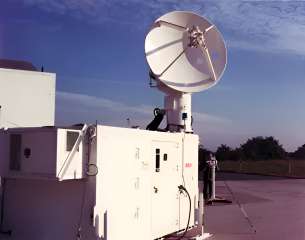
Figure 1: AN/TPQ-39


| Specifications | |
|---|---|
| frequency: | 5 400 … 5 900 MHz
(C band) |
| pulse repetition time (PRT): | |
| pulse repetition frequency (PRF): | 640 Hz |
| pulsewidth (τ): | 1.5 µs |
| receiving time: | |
| dead time: | |
| peak power: | 259 kW |
| average power: | |
| instrumented range: | 126 NM (≙ 233 km) |
| range resolution: | |
| accuracy: | |
| beamwidth: | |
| hits per scan: | |
| antenna rotation: | |
| MTBCF: | |
| MTTR: | |
AN/TPQ-39
AN/TPQ-39 DIR (Digital Instrumentaion Radar) is operating in the C band (IEEE designation) or in the G band (NATO designation) instrumentation radar developed in 1972 as a universal range instrument. It was the first instrumentation radar to use digital computer to provide radar subsystem functions. TPQ-39 is a portable instrument designed for flexibility, low cost, and moderate accuracy. It utilizes a general-purpose digital computer to minimize hardware while maximizing reliability and flexibility.
The radar also uses G-band transponders to improve tracking performance. The system features raster scan, automatic target acquisition, and automatic and manual bandwidth and coast control. The transmitter used a magnetron.
Five of these radar sets were built between 1972 and 1977.